

You’ve probably heard this before…
“You need to post every day. Google rewards consistency. The more you publish, the faster you’ll grow.”
Some bloggers hear that and dive in. They build a content calendar, set a daily quota, and start grinding. Others hear it and never start at all… because the idea of writing something every single day feels impossible on top of everything else they’re doing.
Both groups are responding to advice that was bad in 2012, and is even worse in 2026.
Quick note: I originally wrote this post back in 2012, when this advice was already a problem. I’m updating it now for the way the internet actually works in 2026… because if anything, the case against daily posting has gotten dramatically stronger.
Let me bust this myth. Because it’s costing people years of wasted effort.
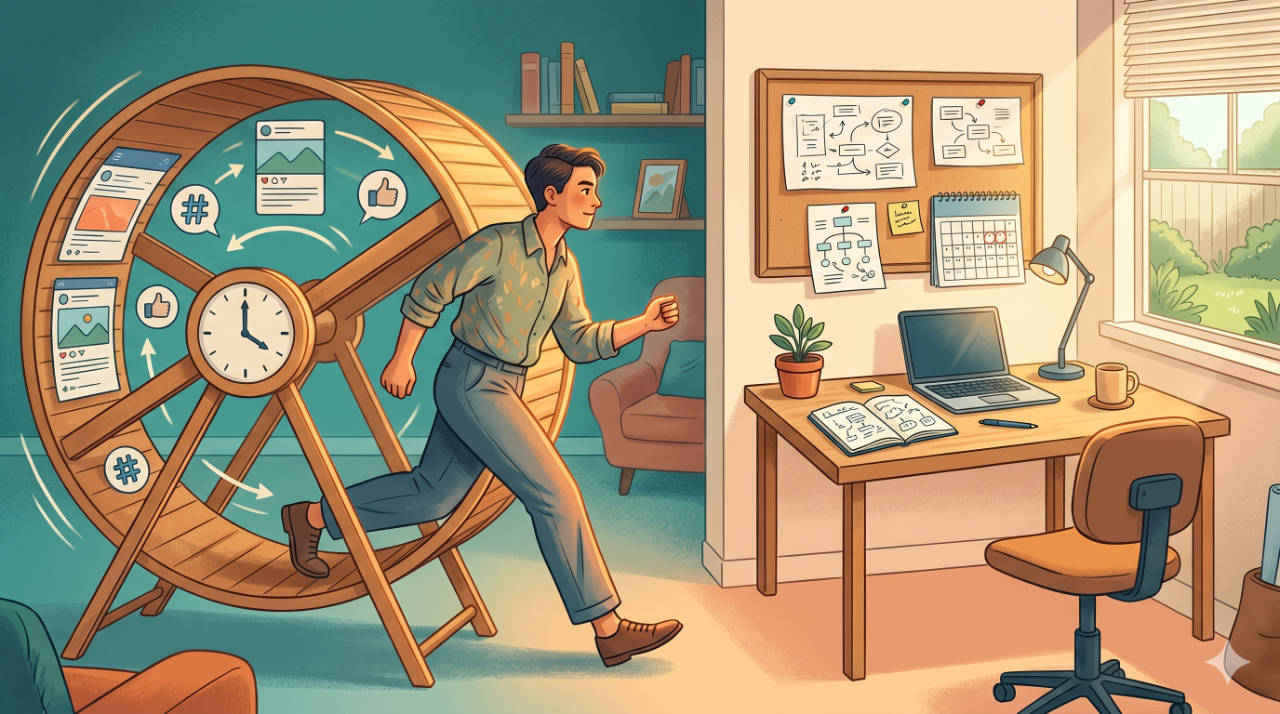
You Build Your Own Treadmill
Daily posting becomes a treadmill almost immediately. You hop on it because somebody told you to, and you start writing.
And writing.
And writing.
Not because your audience is asking for more. Not because you have something fresh and important to say every single day. But because you set a quota for yourself and you don’t want to break the streak.
It feels productive. It feels like progress. But it isn’t either.
Eventually, the days come when you struggle with what to write about. You’re not feeling it. You don’t have anything new to say. But the quota is still there, staring at you. So you force it.
And here’s what happens next.
Your Content Quality Tanks
This is inevitable. Unless you are uniquely gifted, daily output means dropping output quality. The posts get shorter. They repeat themselves. They scratch the surface instead of going deep.
You stop writing things that change the reader’s perspective and start writing things that just… fill space.
In 2012, this was a problem because your audience would notice. In 2026, it’s a much bigger problem because everyone is doing it. The internet is flooded with AI-generated content, low-effort SEO posts, and surface-level “10 tips” articles that all say the same thing.
If your blog is contributing to that noise, you’re not standing out. You’re getting drowned out.
Your Audience Tunes You Out
There are two ways daily posting hurts your audience relationship.
One: If your content is mediocre (because of the volume), readers learn to ignore you. They might subscribe, but they stop opening. They stop clicking. You become background noise.
Two: Even if you somehow manage to publish high-quality content every day, you can flood your audience. You become a firehose. Instead of treating each post as something worth paying attention to, they start checking in only when they’re in the mood. The release of a new post stops being an event.
Either way, you’ve trained your audience to not care.
The bloggers and creators who actually have engaged audiences in 2026 are the ones who show up less, but with more weight. When they publish, people pay attention. When they email, people open. Because they’ve earned the assumption that what they put out is worth the time.
You can’t earn that assumption while you’re cranking out daily filler.
The 2026 Reality: Quality > Quantity By An Even Wider Margin
The internet has changed. Search has changed. Audience attention has changed.
Google has spent the last several years trying to surface helpful, in-depth, original content over the high-volume listicle factories that used to dominate. EEAT (Experience, Expertise, Authoritativeness, Trustworthiness) is the framework now. One genuinely great post that demonstrates real expertise will outperform fifty mediocre posts that just repeat what’s already out there.
AI has accelerated this. With anyone able to generate a “blog post” in 30 seconds, the value of a generic post has collapsed. The only content that stands out now is content that has a real human perspective, real experience behind it, and depth you can’t fake.
That’s not a daily output problem. That’s a quality problem. And you can’t solve a quality problem by writing more.
The Hidden Cost: What You’re NOT Doing
Here’s the part most people miss.
When you spend all your time feeding the daily blog treadmill, you’re not doing the things that actually grow a business:
- You’re not creating products
- You’re not building your email list strategically
- You’re not nurturing the subscribers you already have
- You’re not promoting your existing content
- You’re not building partnerships or relationships
- You’re not auditing what’s already on your site to make sure it still works
A blog isn’t a business. It’s a marketing vehicle for a business. And if your entire week is spent feeding the blog, you have no time left to build the business behind it.
This is the 80/20 rule in action. Most bloggers spend 80% of their time on activities that produce 20% of their results. Daily posting is usually the biggest culprit.
How To Actually Tell If A Post Is Worth Writing
I’ve told you to publish less and make every post count… but how do you actually judge that? What’s the difference between a post worth writing and one you should skip?
Here’s the test I use.
Run it through this question first: Could a thousand other people on the internet write this exact same post?
If the answer is yes, don’t write it. Skip it. The internet does not need another generic “5 Tips For Writing Better Headlines” article that says the same things every other one says. There’s no shortage of that content. There’s a massive shortage of content that has you in it.
A post is worth writing if it has at least two or three of these:
- Your personal experience with the topic. Have you actually done the thing? Have you lived through the problem? Concrete examples from your own work are worth more than any general framework, because they’re proof you actually know what you’re talking about. “When I migrated my site to a new host last year, here’s what broke and how I fixed it” beats “Tips for migrating your website” every single time.
- A backstory. How did you come to have this opinion or this method? What did you used to believe that turned out to be wrong? What changed your mind? Backstory creates context, and context creates trust. It also makes the post readable in a way that pure tactical content never is.
- A specific person you’re writing for. Not “people who want to grow their business.” That’s not a person. Write for the specific reader you have in mind… the one who’s stuck on the specific thing you’re addressing. The more specific the reader, the more powerful the post. Generic readers get generic content; specific readers get something that feels like it was written for them.
- A counter-intuitive angle. What does most of the advice on this topic get wrong? What do you think that disagrees with conventional wisdom? If your post just confirms what everyone already knows, it has no reason to exist. The posts that get shared, remembered, and referenced are the ones that challenge an assumption.
- Real numbers, real situations, real specifics. Vague posts are forgettable. “After three months of doing this, my email open rate went from 18% to 31%” is something a reader can act on. “Email open rates can improve with the right strategy” is meaningless filler.
- A clear takeaway. What is the reader supposed to do differently after reading this? If the answer is “feel inspired” or “agree with you,” that’s not enough. A good post leaves the reader with a specific shift in thinking or a specific action to take.
- Something only you could write. This is the highest bar. Could a junior writer with access to ChatGPT produce this exact post? If yes, why are you the one writing it? Your value as a content creator is the stuff that comes from your specific experience, your specific opinions, your specific way of seeing things. Lean into that. The internet has plenty of generic. It doesn’t have plenty of you.
If a post idea passes most of those tests, write it. If it fails most of them, skip it. You don’t need to write that one. Save your time and energy for the posts that are actually worth your reader’s attention.
What To Do Instead
Beyond the quality test, here’s the broader approach to take:
- Publish when you have something genuinely worth saying. Not when the calendar tells you to. If that’s once a week, great. If it’s twice a month, also great. The frequency matters far less than the substance.
- Update old content instead of always creating new. A solid post from two years ago, updated to reflect current reality, often outperforms three new posts. Your archive is an asset. Treat it like one.
- Reinvest the saved time into the business. Use the hours you used to spend writing filler to build your products, work on your funnel, talk to customers, and improve what you already have.
- Treat your blog as a marketing channel, not a journal. Every post should serve the business. If a post doesn’t build trust, generate leads, or move someone toward an offer… why is it on the site?
The Bottom Line
Posting every day was always questionable advice. In 2026, with the content landscape the way it is, it’s actively harmful. You’ll burn out, your quality will suffer, your audience will tune out, and your business will starve while you feed the blog.
Slow down. Publish less. Make what you publish actually count.
That’s how you build something worth reading… and a business worth running.
If your blog has become a treadmill and you’d like help stepping off of it, this is exactly the kind of situation we can untangle on a Strategy Call. We’ll look at where your time is actually going, what your blog should actually be doing for you, and put together a plan that prioritizes results over output.