

Most solopreneurs running an online business have no clear picture of what their business actually is — structurally.
They have a website. They have some content. Maybe an email list. A product or two. They do “stuff” and hope it adds up. But ask them to draw their business as a system… what its parts are, how they connect, where the breakdowns live… and most can’t.
This is why so many online businesses feel like a hot mess. Not because the work is bad. Because the structure is undefined.
The thing is, every business — large or small, online or offline, solo or 500 employees — has the same fundamental set of functions. They might be called different things. They might be staffed differently. But they’re always there. And when you can clearly see them, the chaos suddenly has a shape.
In this post, I want to walk you through the 7 functions every business has, the order they connect in, and how they form a self-perpetuating cycle when it’s working.
The Structure: One Function Above, Six In A Circle
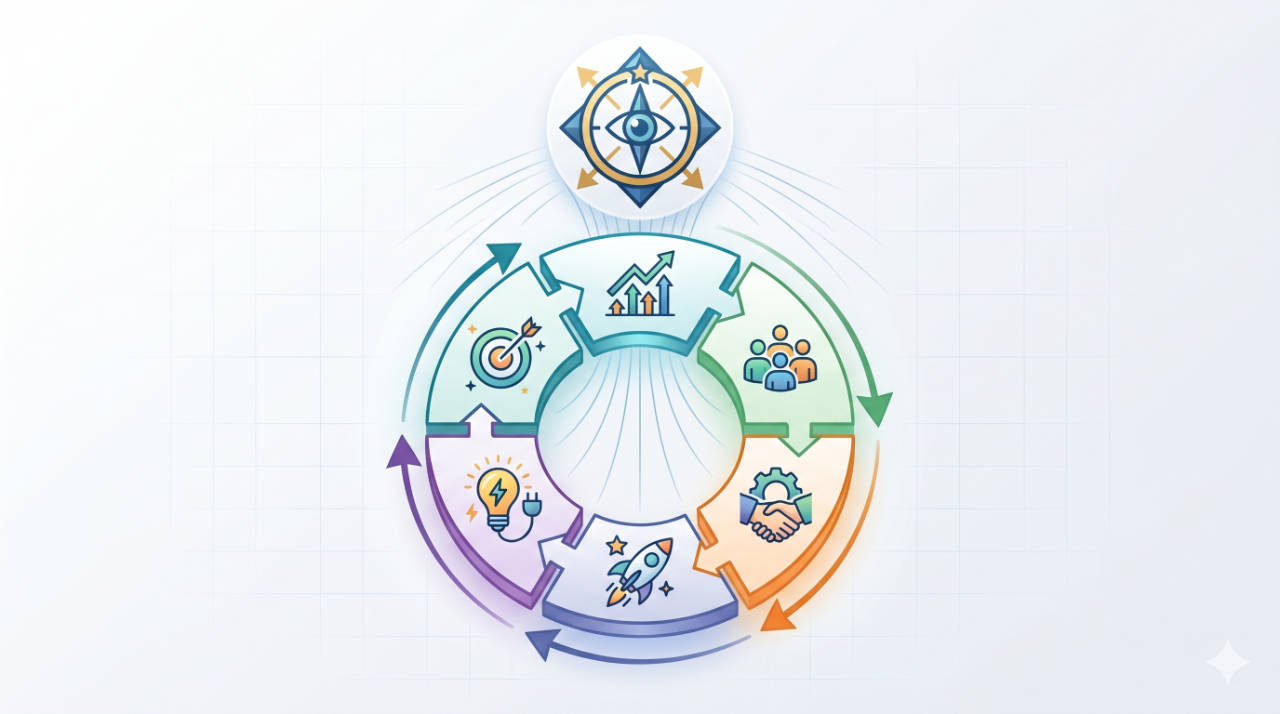
Here’s the framework at a glance:
Function 7 (Executive) sits above everything else. It provides direction, strategy, and leadership. It’s not part of the day-to-day flow — it’s the layer that determines what the day-to-day flow is for.
Functions 1 through 6 form a circular flow. People enter the business at Function 1. They flow through each function in order. Function 6 generates output that brings new people back to Function 1, completing the cycle.
When it’s all running, it’s a flywheel. When one function is broken or neglected, the cycle stalls — and so does the business.
Let’s walk through each one in order.
Function 7: Executive
This is where the business decides things. Strategy, vision, direction. What you’re building, who it’s for, what success looks like, what you’ll say no to.
Without an active Executive function, the business drifts. Every decision gets made reactively, in the moment, with no anchor. You end up chasing whatever trend or shiny object lands in your inbox that day.
This function sits above the other six because it doesn’t process customers or transactions. Instead, it shapes how the other six are run, what they’re aimed at, and what gets prioritized when something has to give.
Common solopreneur failure mode: Skipping Executive entirely because “I’m just one person, I don’t need to do strategy.” Then wondering why nothing connects.
Stat to track: Whether you actually have a written strategic plan that’s reviewed regularly — quarterly at minimum.
Function 1: Communications
This is the front door of the business. Where new people first make contact.
Incoming emails. Form submissions. Opt-ins. Inquiries. Support requests. The very first touch point a person has when they decide to interact with you. This function also covers the internal infrastructure that lets the business communicate with itself and the outside world cleanly — your inbox setup, your CRM, your contact form, your tools, your documented processes. Without these “office” elements running, every other function takes longer than it should.
When Function 1 is working, new people land in your system smoothly and the business operates on solid internal infrastructure. When it’s broken, prospects bounce off, support tickets get lost, and you’re constantly putting out fires you shouldn’t be having.
Common solopreneur failure mode: No real contact strategy beyond “email me.” No internal documentation. Things “live in your head” until they fall out.
Stat to track: Volume of incoming and outgoing communications. How quickly inquiries get a real human response.
Function 2: Marketing
Once a person is in the system, Marketing converts interest into customers. Offers, sales pages, promotional emails, webinars, strategy calls, follow-up sequences. Anything that takes someone from “interested” to “purchased.”
This is where the active promotion to people already in your orbit happens. It’s also where pricing strategy and offer design live — what you sell, how you sell it, and how you nurture prospects toward a yes.
Common solopreneur failure mode: Building a great audience but never asking them to buy anything. Or having a fuzzy offer that nobody can figure out how to purchase.
Stat to track: Sales count, revenue, conversion rate from leads to customers.
Function 3: Treasury
Managing the money. Money in. Money out. What’s profitable. What you owe. What you have. Cash flow. Pricing decisions. Margins. Tax preparation.
This is the easiest function to ignore until tax time, and that’s a costly mistake. A business that doesn’t know its numbers is a business running blind.
Common solopreneur failure mode: Avoiding the numbers because they’re scary or boring. Realizing six months later that your most popular offering is actually losing money.
Stat to track: Monthly revenue, monthly expenses, profit margin per offer. Even simple is fine — what matters is that someone’s looking.
Function 4: Production
Actually doing the work. Making the thing. Delivering the service. Recording the course. Writing the membership content. Performing the consulting hours. Building the deliverable. Whatever you sell, this is where it gets produced.
This is often the function solopreneurs are best at — because it’s usually the work they enjoy most. The temptation is to spend almost all their time here.
Common solopreneur failure mode: Production becomes a hiding place. They spend all their time on the craft and neglect every other function.
Stat to track: Output per week — units of work, hours of delivery, products shipped, calls completed.
Function 5: Quality
Making sure what you delivered actually works for the customer. Support. Onboarding. Retention. Asking for feedback. Fixing problems. Making sure that what was promised matches what was delivered.
Without this function, customers drift away quietly. They don’t tell you. They just leave. And refilling the bucket through Marketing and Public is dramatically more expensive than keeping who you already have.
Common solopreneur failure mode: Treating customer care as an interruption rather than a function. Slow support. No follow-up after a sale. No system for retention.
Stat to track: Customer satisfaction (response times, NPS, refund rates). Retention if you have recurring revenue.
Function 6: Public
The outbound, external-facing side of the business. Content marketing. Podcasts. Social media. Success stories. Testimonials. Affiliate relationships. Public-facing brand work. Anything that puts the business in front of new people who haven’t entered Function 1 yet.
This is critical because Function 6 is what closes the loop. Happy customers (who came out of Function 5) become testimonials, referrals, and case studies that get featured in Function 6 — which generates new awareness and brings new people back to Function 1. The cycle starts over.
When Function 6 is working, your business has a flywheel. When it’s not, you have to keep paying for traffic just to refill the top of the funnel.
Common solopreneur failure mode: Never collecting success stories or testimonials. Doing all marketing as paid acquisition with no organic content engine. Forgetting that satisfied customers are the cheapest source of new customers.
Stat to track: Content output, audience growth (social, podcast, email), referral count.
Why The Cycle Matters
When all six core functions are running and Executive is providing direction, you have a self-perpetuating system:
- Function 6 (Public) generates awareness → new people learn about the business
- Function 1 (Communications) receives them → they enter the system
- Function 2 (Marketing) converts them → they become customers
- Function 3 (Treasury) handles the money
- Function 4 (Production) delivers the value
- Function 5 (Quality) ensures it landed → they become happy customers
- Function 6 (Public) turns them into testimonials and content → which brings new people back to Function 1
- Function 7 (Executive) sits above the whole thing, deciding what to optimize, what to scale, what to stop
This is a flywheel. The more you’ve put into it, the more it produces, with less effort over time.
But here’s the catch: the cycle moves at the speed of its weakest function. If any one of the six is broken, the whole flywheel slows down. Marketing without Quality means new customers leave fast. Production without Public means nobody knows what you’ve built. Communications without Executive means no clear direction for any of it.
This is why solopreneurs need awareness of all seven, even when they’re a one-person team running every function themselves.
From Functions To An Organizing Board
These 7 functions aren’t theoretical. They’re closer to a natural law of how businesses work. Every functioning business — whether anyone has labeled it this way or not — has all 7 of these things happening somehow.
Once you accept that, you can take this framework and use it to lay out an actual organizing board for your business… a structural map that shows what each function does, what its measurable output is, and who’s responsible for handling it.
Here’s the interesting part: the organizing board for a solopreneur looks structurally identical to the organizing board for a 500-person company.
The boxes are the same. The functions are the same. The cycle is the same. The difference isn’t in the structure… it’s in who fills the boxes.
In a large company:
- Each function is a department
- Each department has multiple people
- Each person specializes in a slice of one function
- One team handles Communications, another handles Marketing, another handles Production, and so on
In a solopreneur business:
- The functions are still all there
- All the boxes still need to be filled
- But one person — you — fills all of them
- You wear all the hats
When you map your business as an org board, the value isn’t that you suddenly look like a corporation. The value is that you can clearly see — on paper — which hats you’re actively wearing, which ones you’ve been neglecting, and which functions are quietly running on autopilot (poorly, usually) without your conscious attention.
This is also why this framework scales. The same org board that works for a solopreneur today works for a 5-person team next year and a 50-person operation five years from now. As you grow, you don’t replace the framework. You start handing individual functions (or pieces of them) to other people.
As a solopreneur, you have three ways to handle the fact that you’re filling all seven boxes yourself:
- Divide your time among the functions deliberately. Most solopreneurs spend almost all their working hours in one or two functions (usually Production, maybe Marketing) and quietly neglect the rest. The fix is being intentional about giving each function at least some attention every week, even if it’s small. Block time on your calendar for the functions you’d otherwise avoid.
- Hand off pieces to other people. As you grow, you can hand off individual functions — or sub-functions — to contractors, virtual assistants, or hires. The org board makes it obvious what to delegate first: usually the function you’re worst at, or the one consuming the most time without producing the most value.
- Use AI to handle parts of it automatically. This is the 2026 reality. Each of the seven functions has work that AI can help you do, or do entirely on your behalf. AI isn’t a replacement for you… it’s a way to extend one person’s coverage across all seven functions in a way that wasn’t possible a couple of years ago.
Whether you’re a solo operator now or planning to grow into a team, the seven functions don’t change. The org board doesn’t change. Only the question of who fills each box changes as the business evolves.
How To Put This Framework To Work
The way to apply all of this in practice comes down to three things:
1. Don’t pretend any function doesn’t exist. Every function happens whether you give it attention or not. Production happens. Treasury happens (when bills come due). Public happens (or doesn’t). Pretending you don’t have a Marketing function because “I’m not really doing marketing” doesn’t make Marketing go away — it just means it’s running poorly.
2. Identify your weakest function and fix that one. Once a quarter, audit each of the seven. Be honest about which ones are getting attention and which ones are being neglected. Your weakest function is your bottleneck — the constraint slowing the entire cycle. (See my post on the Theory of Constraints for solopreneurs for how to find that bottleneck more rigorously.)
3. Lean on AI to extend your reach. Each of the seven functions has work that AI can support or even handle outright. A few examples:
- Executive: Strategic brainstorming partner, scenario analysis, challenging your assumptions
- Communications: Email triage, draft replies, document SOPs
- Marketing: First drafts of sales copy, headline ideation, email sequences
- Treasury: Number crunching, P&L analysis, budget review
- Production: Depending on what you sell, AI can dramatically accelerate certain delivery work
- Quality: Support response drafting, feedback summarization
- Public: Content first drafts, podcast outlines, social repurposing
The trick is the same as always: AI works best when you give it a defined function to support, not a vague request. The framework above gives AI a clear role to play in each of the seven functions of your business.
Where To Take This From Here
If your business has been feeling chaotic, stuck, or like you’re working hard but not getting traction… map it against these seven functions. The exercise alone will usually tell you exactly where the problem is.
For each function, honestly answer:
- Is this function actually running, or is it being neglected?
- What’s the current stat or measurement?
- When was the last time I deliberately worked on this function (not just reacted to a fire inside it)?
Then pick the weakest function. Fix that one. Watch what happens to the rest of the cycle.
Don’t try to overhaul everything at once. The whole point of this framework is that the system improves when the weakest part improves.
If you want help walking through this for your specific business — figuring out which functions are actually running well, which ones are bottlenecked, and what to do about the gap — that’s exactly what we work through on a Strategy Call. One hour together, an honest assessment of where your business actually stands, and a clear plan to move forward.