
Top 8 Mistakes Way Too Many Blog Owners Make
Most blog owners are making the same handful of mistakes — and most of them come down to not thinking about the site from the visitor’s perspective. Here are the top 8 I see over and over.

When I work with clients on their sites — whether through a strategy call, a site review, or full Concierge management — I see a lot of the same mistakes. Over and over again.
They’re trying. Hard. They’re doing what they think should work, but it just isn’t producing results. And that’s usually what brings them to somebody like me.
Here’s what I’ve learned: it is one thing to talk about driving traffic. But it is another thing entirely to look at an existing site and make sure it actually does something with that traffic. So many blog owners are laser-focused on the traffic side that they completely forget about the conversion side.
How many visitors are getting on your email list? Are you making any sales? Are people taking any action at all? Or are you just squandering every visit, sending people away with nothing to show for it?
Here’s what I see the most.
#1 — No Clear Offer Or Next Step
I’m still amazed by how many blogs I come across that have no obvious next step for the visitor. There’s no opt-in offer — or if there is one, it’s buried in a footer widget where nobody will ever find it.
If you have any intentions with your blog that go beyond talking to yourself, you need an email list. This isn’t a “someday maybe” thing. In the world of online business, building your list is as fundamental as breathing.
And the #1 job of your blog is to build that list. All other concerns are secondary.
But it goes deeper than just having an opt-in form. You need a real offer. “Subscribe to my newsletter” isn’t an offer — it’s a request. Nobody wakes up wanting more email. Give them something specific and useful in exchange for their email address. A checklist. A short guide. A resource they can use right now. If you’re stuck on what to offer, I put together 45 lead magnet ideas inside the free Solopreneur Toolkit to get you started.
Make it visible, relevant to what they’re already reading, and dead-simple to grab.
#2 — Poor Management Of Attention
Attention is like a current, and it has to be managed the same way you’d manage the flow of water. When a person arrives on your site, their attention will land somewhere, and from there it will flow somewhere. Your job is to control where it lands and where it flows — toward the things you want them to do.
Most sites mismanage this badly. The typical blog crams so much onto the screen that there’s no focal point at all. The reader’s attention scatters in every direction, and they’re far more likely to just leave.
In other cases, the site captures attention just fine — a compelling headline, a strong hero image — but then drops the ball. The attention hits a dead end. There’s no button to click. No form to fill out. No logical next step. The flow of attention slams into a wall.
This also shows up at the site-wide level. A lot of blogs are just a chronological list of posts. The reader lands on the homepage, sees whatever was published most recently, and has no idea where to start or what matters most. There’s no guided path. No “start here.” No structure. Your reader shouldn’t have to figure out your site like a puzzle.
Think of your site like a hallway with doors. Each page should lead naturally to the next one. If a visitor ever lands on a page and thinks “now what?” — that’s a design failure.
Managing attention starts with knowing exactly what the purpose of your site is and what you want people to do. Then you use layout, design, and visual hierarchy to guide their eyes toward those things — deliberately.
#3 — Stuck In Your Own Head
When it’s your site, you develop tunnel vision. You start doing things that you think are cool. You have elements on the site that make total sense to you, but your new visitor has absolutely no idea what they mean or why they should care.
You care because it’s your baby. They don’t care one bit about you, how long you’ve been in business, how great your customer support is, or how clever your tagline is.
All they care about is themselves. They care about what you can do for them.
One of the best ways to break out of this tunnel vision is to have other people go through your site and tell you their honest reactions. What’s the first thing their eyes land on? Can they figure out what you do? Can they find what they’re looking for? Does your content make sense to someone who’s never heard of you?
If you can’t get that feedback from friends or colleagues, consider getting a professional set of eyes on it. That’s one of the things I do on a Strategy Call — we’ll walk through your site together and you’ll walk away with a clear action plan for what to fix.
#4 — Weak, Boring Headlines
This one hasn’t changed in the entire time I’ve been doing this. Flat, boring headlines everywhere. It’s like the writer just shrugged and dropped in whatever came to mind first.
A headline has one job: make people want to read the next line. That’s it. If your headline doesn’t create at least a flicker of curiosity, interest, or “that’s for me” recognition, it has failed.
Here’s an example. Say you run a site about video production. A post titled “Lighting for Video” is flat as a pancake. It’s vague and isn’t going to hook anyone. Now compare: “How To Light Your Videos Like a Pro Without Spending a Fortune.” That speaks to a specific desire and a specific concern. It enters the conversation already happening in the reader’s head.
Every headline should answer the reader’s unspoken question: “Why should I care?” If it doesn’t answer that, rewrite it. If you want a head start, I put together a list of 58+ headline formulas you can swipe and adapt for almost any topic.
#5 — “We” When You Really Mean “I”
If you’re a solopreneur — and most of you reading this are — stop using “we” on your site. There is no “we.” There’s you.
Somewhere along the line, people got it in their heads that “we” sounds more professional. More established. Like a real company. In reality, it just sounds inauthentic. Your visitors can tell. And in a world where people are drawn to real humans over faceless brands, pretending to be a team when you’re one person actually hurts you.
People want to do business with a real person. They want to know who’s behind the curtain. Lean into that. It’s an advantage, not a weakness.
#6 — Plugin And Tool Bloat
This is the modern version of a problem I’ve seen for over a decade. Back in the day, it was sidebar widgets — people stuffed every available widget into the sidebar just because they could. Today, it’s plugins and third-party tools.
“Oh, there’s a plugin for that? Let me install it.” And then another. And another. Before you know it, you’ve got 40+ plugins, half of which conflict with each other, and your site loads like it’s on dial-up. I call this the Frankenstein site — a cobbled-together mess of parts that were never meant to work together.
But it’s not just about speed. Every unnecessary tool adds complexity. More things to update. More things to break. More decisions to make about stuff that doesn’t actually move the needle.
Ask yourself this about every plugin and tool on your site: Does this directly support the thing I want visitors to do? If the answer is no, it probably doesn’t need to be there. Simplify ruthlessly.
#7 — Trying To Monetize With Ads Instead Of Your Own Offers
If you’re running a blog to market your business — to sell products, services, courses, coaching, or anything of your own — do not plaster banner ads or ad network code all over your site.
Those ads compete directly with your own goals. Every ad is a little exit sign pointing your visitor away from you and toward someone else’s business. And for what? A few dollars in CPM revenue? It’s not worth the trade-off.
Even if you’re not selling anything yet, ads signal to your visitor that your site exists to make ad revenue — not to help them. It cheapens the experience and erodes trust.
The one exception: if your entire business model is ad-supported content (like a media site or news publication). But if you’re a solopreneur with products, services, or an email list to build, ads are working against you.
#8 — Stale, Neglected Content
This is the one almost nobody talks about, but it might be the most damaging over time.
Most bloggers treat content like a conveyor belt. Write a post, publish it, move on to the next one. Do that for a few years and you end up with hundreds of posts — many of which are outdated, inaccurate, full of broken links, or referencing tools and strategies that no longer exist.
That stale content doesn’t just sit there harmlessly. It actively works against you. A visitor lands on an old post through Google, sees outdated information or dead links, and immediately questions your credibility. Search engines notice it too — a site full of thin, neglected content can drag down your entire domain’s authority.
The fix is a content audit. Go through your archive and make a decision on every single post: does this still serve the site’s purpose? Is it accurate? Does it reflect how you do things now? If a post is solid but dated, update it. If it no longer fits your business at all, trash it. This is exactly what I’m doing with my own blog right now — going through every post from the beginning and either rewriting, freshening, or removing it entirely.
Your blog isn’t a journal. It’s a business asset. And like any asset, it needs maintenance.
These eight mistakes all have one thing in common: they come down to not thinking about things from the visitor’s perspective. It’s easy to build a site that makes sense to you. The challenge is building one that works for the person who just showed up for the first time and doesn’t know you from Adam.
If you’re looking at this list and seeing your own site in a few of these, I go deeper on this inside the Perfect Blog Blueprint — a full walkthrough on structuring your blog for conversions. It’s available inside ONEPass.
And if you’d rather have someone just look at your site and handle the fixes, that’s literally what Concierge is for. I manage the whole WordPress stack for you — hosting, performance, design, tools, and strategy — so you can focus on your business instead of fighting with your website.
Popular Right Now

What If Your Website Was Just… Handled?
I manage WordPress sites for creators and small teams who don’t want to fight tech anymore. Hosting, updates, security, performance — plus a real human you can ask anything.
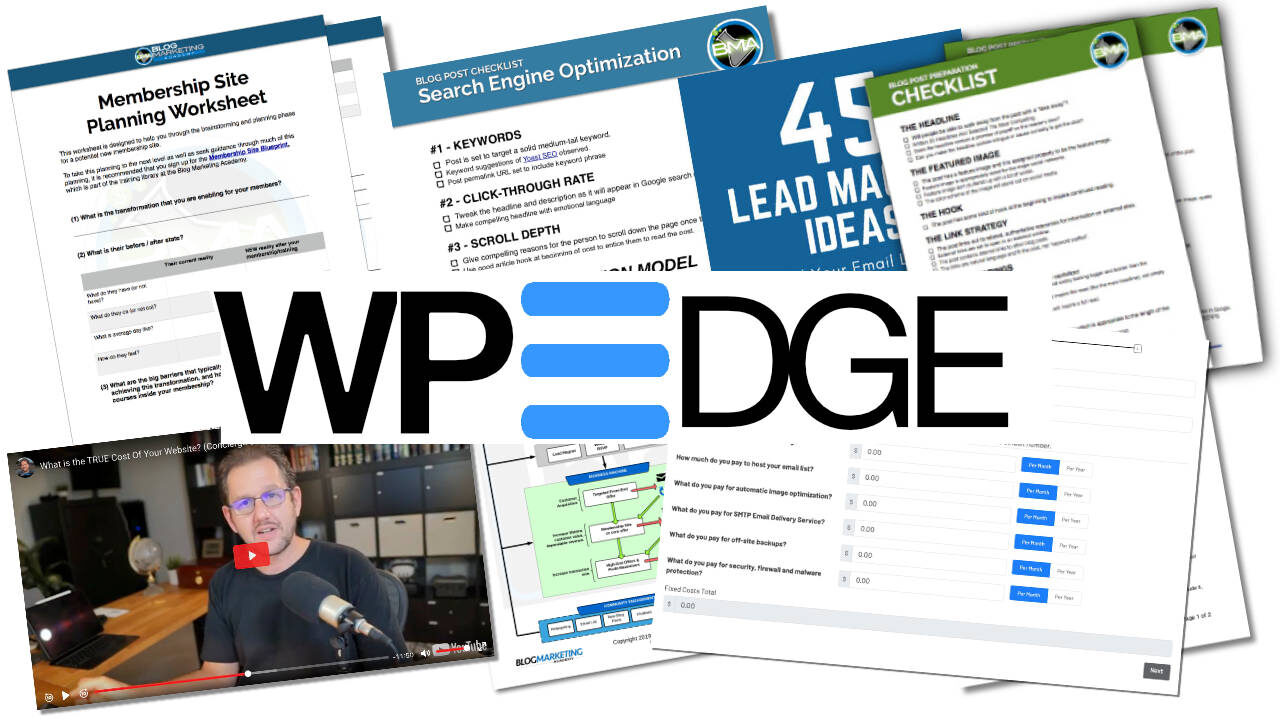
Tools, checklists, and resources for solopreneurs who want to spend less time on tech — and more time growing. With more tools coming regularly. 😎

